
【数据结构与算法】用队列实现栈&&用栈实现队列&&设计循环队列
温馨提示:这篇文章已超过385天没有更新,请注意相关的内容是否还可用!
🌠作者:@阿亮joy.
🎆专栏:《数据结构与算法要啸着学》
🎇座右铭:每个优秀的人都有一段沉默的时光,那段时光是付出了很多努力却得不到结果的日子,我们把它叫做扎根

目录
- 👉用队列实现栈👈
- 用两个队列实现栈
- 用一个栈实现队列
- 👉用栈实现队列👈
- 👉设计循环队列👈
- 👉一道小小的选择题👈
- 👉总结👈
👉用队列实现栈👈
请你仅使用两个队列实现一个后入先出(LIFO)的栈,并支持普通栈的全部四种操作(push、top、pop 和 empty)。
实现 MyStack 类:
- void push(int x) 将元素 x 压入栈顶。
- int pop() 移除并返回栈顶元素。
- int top() 返回栈顶元素。
- boolean empty() 如果栈是空的,返回 true ;否则,返回 false 。
注意:
- 你只能使用队列的基本操作 —— 也就是 push to back、peek/pop from front、size 和 is empty
这些操作。
- 你所使用的语言也许不支持队列。 你可以使用 list (列表)或者 deque(双端队列)来模拟一个队列 ,只要是标准的队列操作即可。
示例:
输入:
["MyStack", "push", "push", "top", "pop", "empty"]
[[], [1], [2],[], [], []]
输出:
[null, null, null, 2, 2, false]
解释:
MyStack myStack = new MyStack();
myStack.push(1);
myStack.push(2);
myStack.top(); // 返回 2
myStack.pop(); // 返回 2
myStack.empty(); // 返回False
提示:
- 1
QDataType data;
struct QueueNode* next;
}QNode;
typedef struct Queue
{
QNode* head; // 头指针
QNode* tail; // 尾指针
int size; // 节点的个数
}Queue;
void QueueInit(Queue* pq);
void QueueDestroy(Queue* pq);
void QueuePush(Queue* pq, QDataType x);
void QueuePop(Queue* pq);
QDataType QueueFront(Queue* pq);
QDataType QueueBack(Queue* pq);
bool QueueEmpty(Queue* pq);
int QueueSize(Queue* pq);
void QueueInit(Queue* pq)
{
assert(pq);
pq-head = pq-tail = NULL;
pq->size = 0;
}
void QueueDestroy(Queue* pq)
{
assert(pq);
QNode* cur = pq->head;
while (cur)
{
QNode* del = cur;
cur = cur->next;
free(del);
}
pq->head = pq->tail = NULL;
}
void QueuePush(Queue* pq, QDataType x)
{
assert(pq);
QNode* newnode = (QNode*)malloc(sizeof(QNode));
if (newnode == NULL)
{
perror("malloc fail");
exit(-1);
}
else
{
newnode->data = x;
newnode->next = NULL;
}
// 队列中没有节点
if (pq->tail == NULL)
{
pq->head = pq->tail = newnode;
}
else
{
pq->tail->next = newnode;
pq->tail = newnode;
}
pq->size++;
}
void QueuePop(Queue* pq)
{
assert(pq);
assert(!QueueEmpty(pq));
// 队列中只有一个节点
if (pq->head->next == NULL)
{
free(pq->head);
pq->head = pq->tail = NULL;
}
else
{
QNode* del = pq->head;
pq->head = pq->head->next;
free(del);
//del = NULL;
}
pq->size--;
}
QDataType QueueFront(Queue* pq)
{
assert(pq);
assert(!QueueEmpty(pq));
return pq->head->data;
}
QDataType QueueBack(Queue* pq)
{
assert(pq);
assert(!QueueEmpty(pq));
return pq->tail->data;
}
bool QueueEmpty(Queue* pq)
{
assert(pq);
return pq->size == 0;
//return pq->head == NULL && pq->tail == NULL;
}
int QueueSize(Queue* pq)
{
assert(pq);
return pq->size;
}
//核心思路:
//1.入数据,往不为空的队列入,保持另一个队列为空
//2.出数据的时候,依次出队头的数据,转移到另一个队列中保存
//只剩一个数据时,pop掉
//不能改变队列的结构,只能调用提供的函数接口
typedef struct
{
Queue q1;
Queue q2;
} MyStack;
MyStack* myStackCreate()
{
// 注意局部变量,出了作用域会销毁
MyStack* st = (MyStack*)malloc(sizeof(MyStack));
//初始化队列
QueueInit(&st->q1);
QueueInit(&st->q2);
return st;
}
void myStackPush(MyStack* obj, int x)
{
// 往不为空的队列中入数据
if(!QueueEmpty(&obj->q1))
{
QueuePush(&obj->q1, x);
}
else
{
QueuePush(&obj->q2, x);
}
}
int myStackPop(MyStack* obj)
{
// 找出谁是空队列
Queue* empty = &obj->q1;
Queue* nonEmpty = &obj->q2;
if(!QueueEmpty(&obj->q1))
{
empty = &obj->q2;
nonEmpty = &obj->q1;
}
// 非空队列前N-1个数据导入空队列,剩下的一个数据就是栈顶元素
while(QueueSize(nonEmpty) > 1)
{
QueuePush(empty, QueueFront(nonEmpty));
QueuePop(nonEmpty);
}
int top = QueueFront(nonEmpty);
QueuePop(nonEmpty);
return top;
}
int myStackTop(MyStack* obj)
{
if(!QueueEmpty(&obj->q1))
{
return QueueBack(&obj->q1);
}
else
{
return QueueBack(&obj->q2);
}
}
bool myStackEmpty(MyStack* obj)
{
return QueueEmpty(&obj->q1) && QueueEmpty(&obj->q2);
}
void myStackFree(MyStack* obj)
{
QueueDestroy(&obj->q1);
QueueDestroy(&obj->q2);
free(obj);
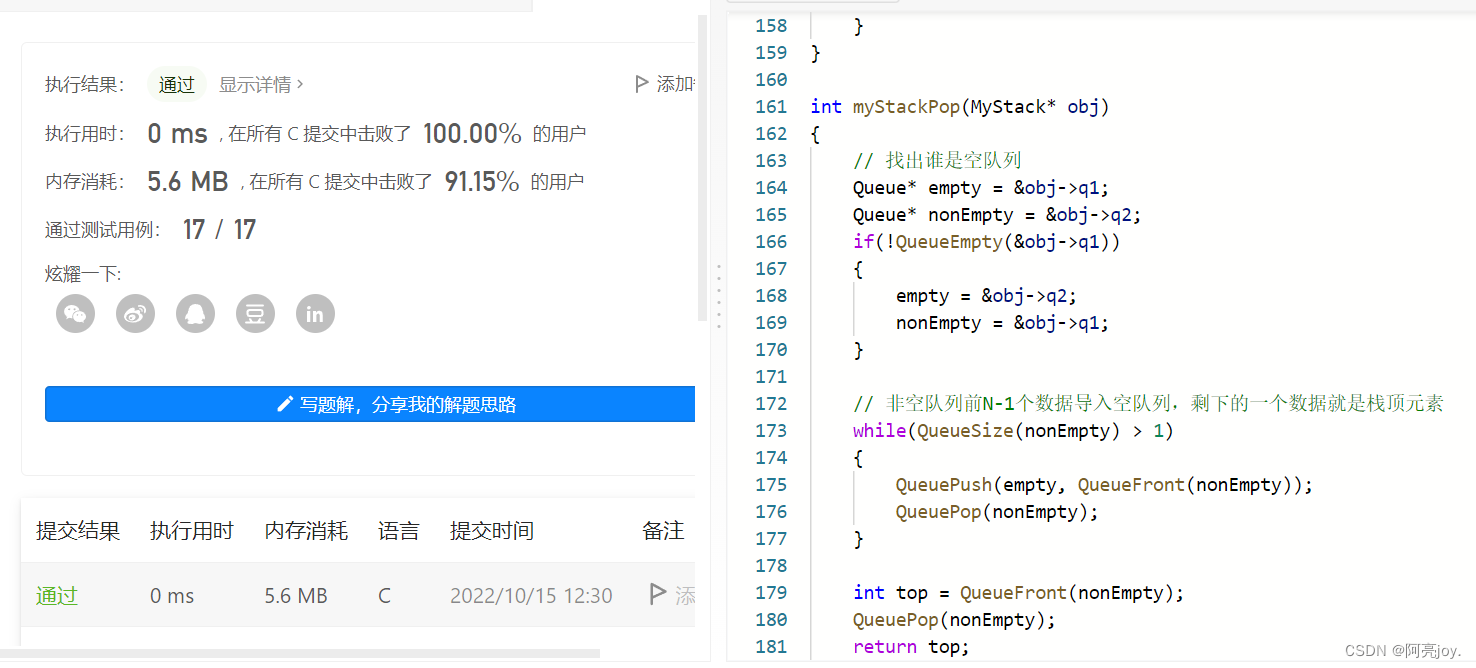
}
用一个栈实现队列
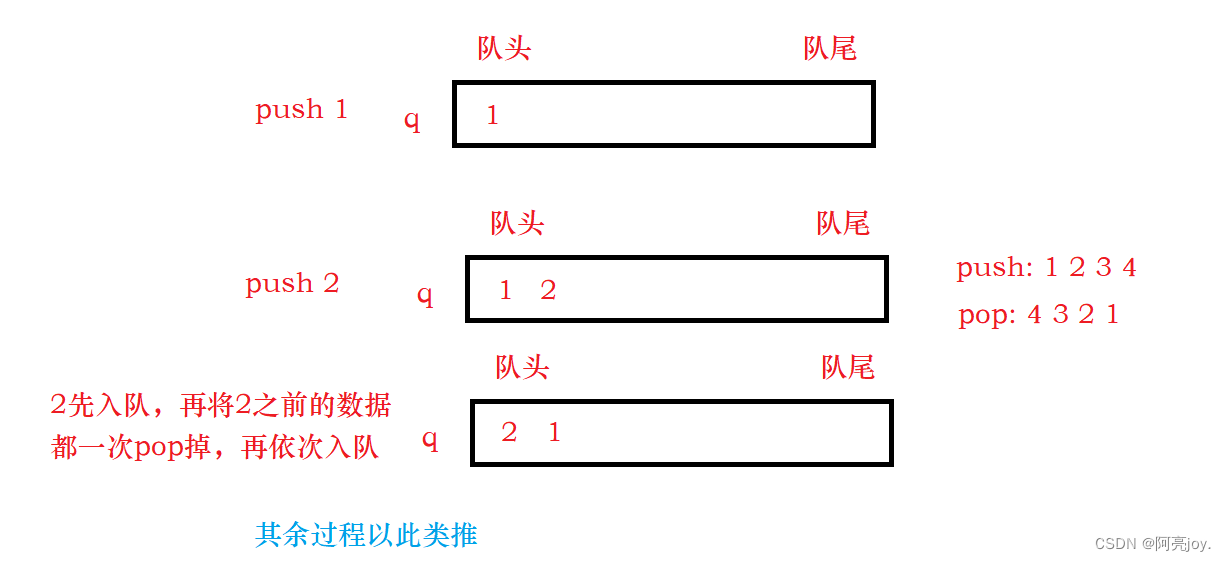
用一个栈如何实现队列呢?其实也很简单,当一个数据入队时,先将该数据入队,然后再将在该数据前面的数据依次 pop 掉,然后又依次入队,就能实现后进先出的栈结构了。如下图所示:
typedef int QDataType;
typedef struct QueueNode
{
	QDataType data;
	struct QueueNode* next;
}QNode;
typedef struct Queue
{
	QNode* head; // 头指针
	QNode* tail; // 尾指针
	int size;    // 节点的个数
}Queue;
void QueueInit(Queue* pq);
void QueueDestroy(Queue* pq);
void QueuePush(Queue* pq, QDataType x);
void QueuePop(Queue* pq);
QDataType QueueFront(Queue* pq);
QDataType QueueBack(Queue* pq);
bool QueueEmpty(Queue* pq);
int QueueSize(Queue* pq);
void QueueInit(Queue* pq)
{
	assert(pq);
	pq->head = pq->tail = NULL;
	pq->size = 0;
}
void QueueDestroy(Queue* pq)
{
	assert(pq);
	QNode* cur = pq->head;
	while (cur)
	{
		QNode* del = cur;
		cur = cur->next;
		free(del);
	}
	pq->head = pq->tail = NULL;
}
void QueuePush(Queue* pq, QDataType x)
{
	assert(pq);
	QNode* newnode = (QNode*)malloc(sizeof(QNode));
	if (newnode == NULL)
	{
		perror("malloc fail");
		exit(-1);
	}
	else
	{
		newnode->data = x;
		newnode->next = NULL;
	}
	// 队列中没有节点
	if (pq->tail == NULL)
	{
		pq->head = pq->tail = newnode;
	}
	else
	{
		pq->tail->next = newnode;
		pq->tail = newnode;
	}
	pq->size++;
}
void QueuePop(Queue* pq)
{
	assert(pq);
	assert(!QueueEmpty(pq));
	// 队列中只有一个节点
	if (pq->head->next == NULL)
	{
		free(pq->head);
		pq->head = pq->tail = NULL;
	}
	else
	{
		QNode* del = pq->head;
		pq->head = pq->head->next;
		free(del);
		//del = NULL;
	}
	pq->size--;
}
QDataType QueueFront(Queue* pq)
{
	assert(pq);
	assert(!QueueEmpty(pq));
	return pq->head->data;
}
QDataType QueueBack(Queue* pq)
{
	assert(pq);
	assert(!QueueEmpty(pq));
	return pq->tail->data;
}
bool QueueEmpty(Queue* pq)
{
	assert(pq);
	return pq->size == 0;
	//return pq->head == NULL && pq->tail == NULL;
}
int QueueSize(Queue* pq)
{
	assert(pq);
	return pq->size;
}
typedef struct
{
    Queue q;
} MyStack;
MyStack* myStackCreate()
{
    MyStack* obj = (MyStack*)malloc(sizeof(MyStack));
    QueueInit(&obj->q);
    return obj;
}
void myStackPush(MyStack* obj, int x)
{
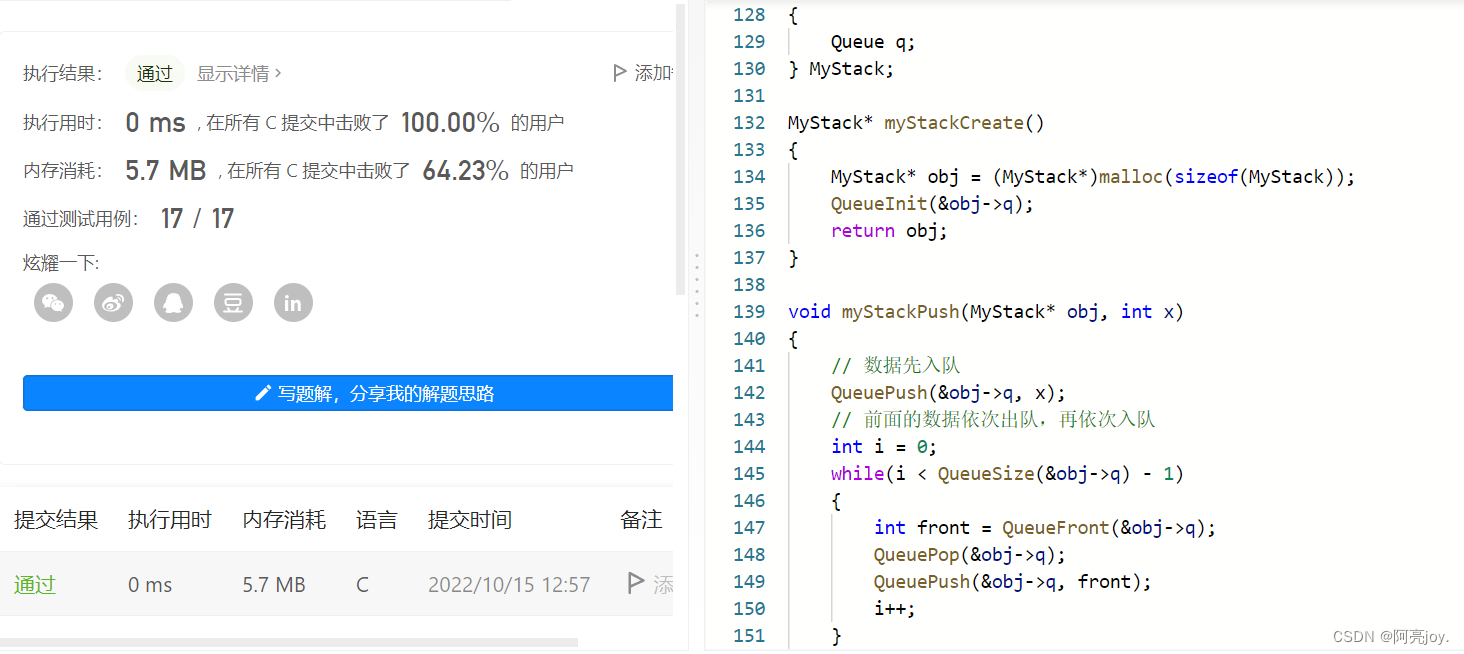
    // 数据先入队
    QueuePush(&obj->q, x);
    // 前面的数据依次出队,再依次入队
    int i = 0;
    while(i q) - 1)
    {
        int front = QueueFront(&obj->q);
        QueuePop(&obj->q);
        QueuePush(&obj->q, front);
        i++;
    }
}
int myStackPop(MyStack* obj)
{
    int top = QueueFront(&obj->q);
    QueuePop(&obj->q);
    return top;
}
int myStackTop(MyStack* obj)
{
    int top = QueueFront(&obj->q);
    return top;
}
bool myStackEmpty(MyStack* obj)
{
    return QueueEmpty(&obj->q);
}
void myStackFree(MyStack* obj)
{
    QueueDestroy(&obj->q);
    free(obj);
}
👉用栈实现队列👈
请你仅使用两个栈实现先入先出队列。队列应当支持一般队列支持的所有操作(push、pop、peek、empty):
实现 MyQueue 类:
- void push(int x) 将元素 x 推到队列的末尾
- int pop() 从队列的开头移除并返回元素
- int peek()返回队列开头的元素
- boolean empty() 如果队列为空,返回 true ;否则,返回 false
说明:
你只能使用标准的栈操作 —— 也就是只有 push to top, peek/pop from top, size, 和 is empty 操作是合法的。你所使用的语言也许不支持栈。你可以使用 list 或者 deque(双端队列)来模拟一个栈,只要是标准的栈操作即可。
示例 1:
输入:
["MyQueue", "push", "push", "peek", "pop", "empty"]
[[], [1], [2],[], [], []]
输出:
[null, null, null, 1, 1, false]
解释:
MyQueue myQueue = new MyQueue();
myQueue.push(1); // queue is: [1]
myQueue.push(2); // queue is: [1, 2] (leftmost is front of the queue)
myQueue.peek(); // return 1
myQueue.pop(); // return 1, queue is [2]
myQueue.empty(); // return false
提示:
- 1
STDataType* a;
int top;
int capacity;
}ST;
void StackInit(ST* ps);
void StackDestroy(ST* ps);
void StackPush(ST* ps, STDataType x);
void StackPop(ST* ps);
STDataType StackTop(ST* ps);
bool StackEmpty(ST* ps);
int StackSize(ST* ps);
void StackInit(ST* ps)
{
assert(ps);
ps-a = NULL;
ps-capacity = ps->top = 0;
}
void StackDestroy(ST* ps)
{
assert(ps);
free(ps->a);
ps->a = NULL;
ps->capacity = ps->top = 0;
}
void StackPush(ST* ps, STDataType x)
{
assert(ps);
if (ps->capacity == ps->top)
{
int newcapacity = ps->capacity == 0 ? 4 : ps->capacity * 2;
STDataType* tmp = (STDataType*)realloc(ps->a, newcapacity * sizeof(STDataType));
if (tmp == NULL)
{
perror("relloc fail");
exit(-1);
}
ps->a = tmp;
ps->capacity = newcapacity;
}
ps->a[ps->top] = x;
ps->top++;
}
void StackPop(ST* ps)
{
assert(ps);
assert(!StackEmpty(ps));
ps->top--;
}
STDataType StackTop(ST* ps)
{
assert(ps);
assert(!StackEmpty(ps));
return ps->a[ps->top - 1];
}
bool StackEmpty(ST* ps)
{
assert(ps);
return ps->top == 0;
}
int StackSize(ST* ps)
{
assert(ps);
return ps->top;
}
//匿名结构体
typedef struct
{
ST pushST;
ST popST;
} MyQueue;
MyQueue* myQueueCreate()
{
MyQueue* q = (MyQueue*)malloc(sizeof(MyQueue));
StackInit(&q->pushST);
StackInit(&q->popST);
return q;
}
void myQueuePush(MyQueue* obj, int x)
{
StackPush(&obj->pushST, x);
}
int myQueuePop(MyQueue* obj)
{
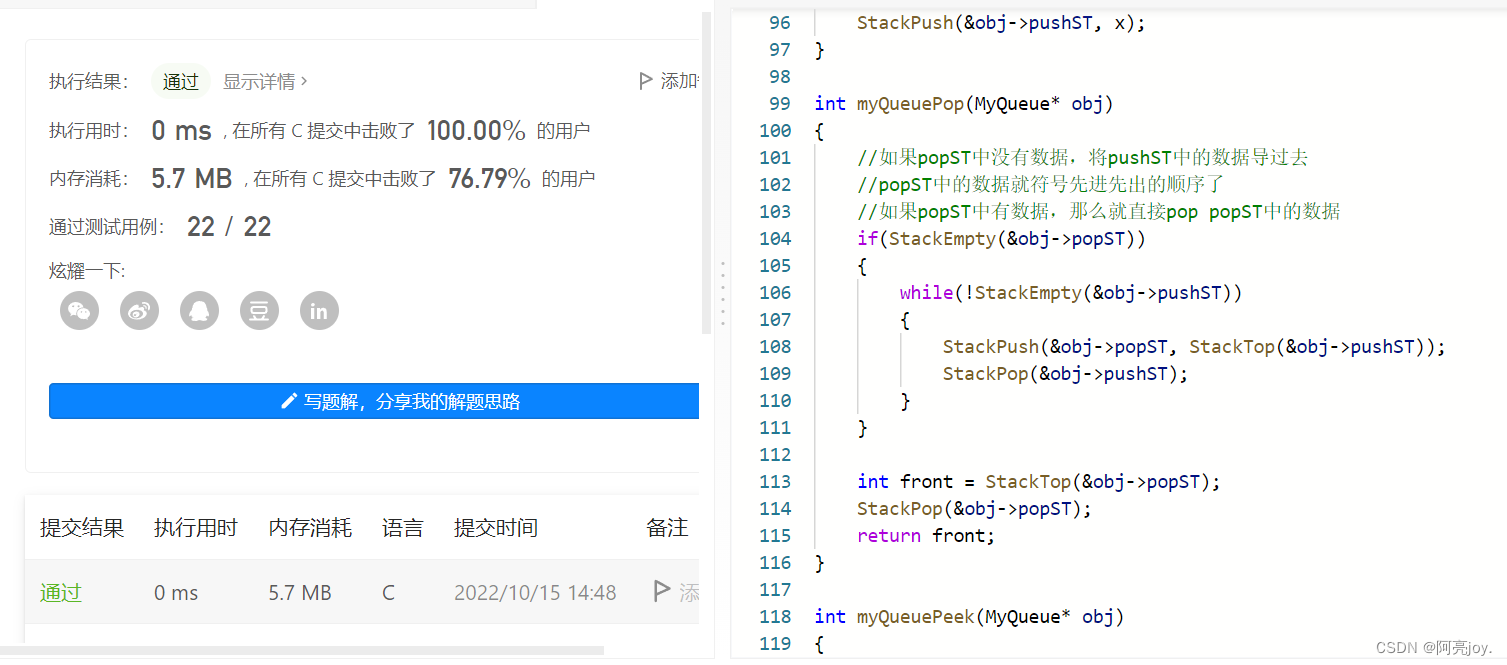
//如果popST中没有数据,将pushST中的数据导过去
//popST中的数据就符号先进先出的顺序了
//如果popST中有数据,那么就直接pop popST中的数据
if(StackEmpty(&obj->popST))
{
while(!StackEmpty(&obj->pushST))
{
StackPush(&obj->popST, StackTop(&obj->pushST));
StackPop(&obj->pushST);
}
}
int front = StackTop(&obj->popST);
StackPop(&obj->popST);
return front;
}
int myQueuePeek(MyQueue* obj)
{
if(StackEmpty(&obj->popST))
{
while(!StackEmpty(&obj->pushST))
{
int top = StackTop(&obj->pushST);
StackPop(&obj->pushST);
StackPush(&obj->popST, top);
}
}
return StackTop(&obj->popST);
}
bool myQueueEmpty(MyQueue* obj)
{
return StackEmpty(&obj->pushST) && StackEmpty(&obj->popST);
}
void myQueueFree(MyQueue* obj)
{
StackDestroy(&obj->pushST);
StackDestroy(&obj->popST);
free(obj);
}
👉设计循环队列👈
设计你的循环队列实现。 循环队列是一种线性数据结构,其操作表现基于 FIFO(先进先出)原则并且队尾被连接在队首之后以形成一个循环。它也被称为“环形缓冲器”。
循环队列的一个好处是我们可以利用这个队列之前用过的空间。在一个普通队列里,一旦一个队列满了,我们就不能插入下一个元素,即使在队列前面仍有空间。但是使用循环队列,我们能使用这些空间去存储新的值。
你的实现应该支持如下操作:
- MyCircularQueue(k): 构造器,设置队列长度为 k。
- Front: 从队首获取元素。如果队列为空,返回 -1 。
- Rear: 获取队尾元素。如果队列为空,返回 -1 。
- enQueue(value): 向循环队列插入一个元素。如果成功插入则返回真。
- deQueue(): 从循环队列中删除一个元素。如果成功删除则返回真。
- isEmpty(): 检查循环队列是否为空。
- isFull():检查循环队列是否已满。
示例:
MyCircularQueue circularQueue = newMyCircularQueue(3); // 设置长度为 3
circularQueue.enQueue(1); // 返回 true circularQueue.enQueue(2); // 返回true circularQueue.enQueue(3); // 返回 true circularQueue.enQueue(4); // 返回 false,队列已满
circularQueue.Rear(); // 返回 3
circularQueue.isFull(); // 返回 true circularQueue.deQueue(); // 返回true circularQueue.enQueue(4); // 返回 true circularQueue.Rear(); //返回 4
提示:
- 所有的值都在 0 至 1000 的范围内;
- 操作数将在 1 至 1000 的范围内;
- 请不要使用内置的队列库。
本道题需要实现的函数接口有:创建循环链表、判断循环链表是否为空、判断循环链表是否为满、数据入队、数据出队、返回队头数据、返回队尾数据以及销毁循环队列。循环队列可以采用数组或者链表的形式实现,但不管使用数组还是链表来实现循环队列,需要多开一个空间或者加个size记录循环队列中数据的个数,否则无法将队列为空和队列为满两种情况区分开。
//重点:循环队列,无论使用数组实现还是链表实现,都要
//多开一个空间,也就意味着,要是一个存k个数据的循环队列
//要开k+1个空间,否则无法实现判空和判满。
//数组实现:空:front == tail  满:(tail+1)%(k+1) == front
//链表实现:空:tail == tail 满:tail->next == front
typedef struct
{
    int* a;
    int front;
    int back;
    int N;
} MyCircularQueue;
MyCircularQueue* myCircularQueueCreate(int k)
{
    MyCircularQueue* obj = (MyCircularQueue*)malloc(sizeof(MyCircularQueue));
    obj->a = (int*)malloc(sizeof(int)*(k+1));
    obj->front = obj->back = 0;
    obj->N = k + 1;
    return obj;
}
bool myCircularQueueIsEmpty(MyCircularQueue* obj)
{
    return obj->front == obj->back;
}
bool myCircularQueueIsFull(MyCircularQueue* obj)
{
    return (obj->back + 1) % obj->N == obj->front;
}
bool myCircularQueueEnQueue(MyCircularQueue* obj, int value)
{
    if(myCircularQueueIsFull(obj))
        return false;

    obj->a[obj->back] = value;
    obj->back++;
    // 当back在最后一个位置时,让back回到下标为0的位置
    obj->back %= obj->N;
    return true;
}
bool myCircularQueueDeQueue(MyCircularQueue* obj)
{
    if(myCircularQueueIsEmpty(obj))
        return false;

    obj->front++;
    // 当front在最后一个位置时,让front回到下标为0的位置
    obj->front %= obj->N;
    return true;
}
int myCircularQueueFront(MyCircularQueue* obj)
{
    if(myCircularQueueIsEmpty(obj))
        return -1;
    else
        return obj->a[obj->front];
}
int myCircularQueueRear(MyCircularQueue* obj)
{
    // if(myCircularQueueIsEmpty(obj))
    //     return -1;
    // else if(obj->back == 0)
    //     return obj->a[obj->N -1];
    // else
    //     return obj->a[obj->back - 1];
    if(myCircularQueueIsEmpty(obj))
        return -1;
    else
        return obj->a[(obj->back - 1 + obj->N) % obj->N];
}
void myCircularQueueFree(MyCircularQueue* obj)
{
    free(obj->a);
    free(obj);
}
自定义循环队列
a:整型指针,指向申请的空间
front:队头的位置
back:队尾位置的下一个位置
N:数组的长度 = k + 1
typedef struct
{
    int* a;
    int front;
    int back;
    int N;
} MyCircularQueue;
创建循环链表
需要注意的是,要给队列循环申请 k + 1个空间,来区分队列是空还是满
MyCircularQueue* myCircularQueueCreate(int k)
{
    MyCircularQueue* obj = (MyCircularQueue*)malloc(sizeof(MyCircularQueue));
    obj->a = (int*)malloc(sizeof(int)*(k+1));
    obj->front = obj->back = 0;
    obj->N = k + 1;
    return obj;
}
判断循环队列是否为空
当obj->front == obj->back时,循环队列为空
bool myCircularQueueIsEmpty(MyCircularQueue* obj)
{
    return obj->front == obj->back;
}
判断循环队列是否为满
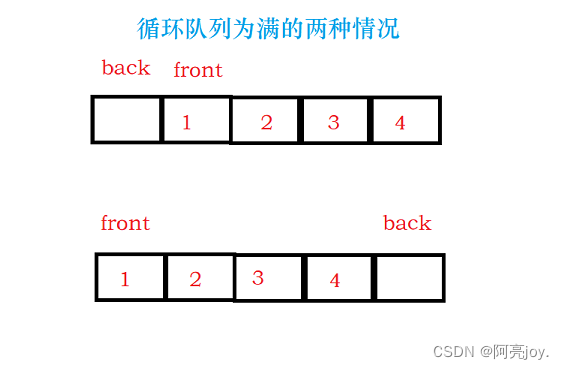
当(obj->back + 1) % obj->N == obj->front时,循环队列为满
bool myCircularQueueIsFull(MyCircularQueue* obj)
{
    return (obj->back + 1) % obj->N == obj->front;
}
数据入队
1.当循环队列为满时,返回 false
2.当循环队列不为满时,数据入队obj->a[obj->back] = value, obj->back++
3.当back在最后一个位置时,让back回到下标为 0 的位置obj->back %= obj->N
bool myCircularQueueEnQueue(MyCircularQueue* obj, int value)
{
    if(myCircularQueueIsFull(obj))
        return false;

    obj->a[obj->back] = value;
    obj->back++;
    // 当back在最后一个位置时,让back回到下标为0的位置
    obj->back %= obj->N;
    return true;
}
数据出队
1.当循环队列为空时,返回 false
2.当循环队列不为空时,数据出队obj->front++
3.当front在最后一个位置时,让front回到下标为 0的位置obj->front %= obj->N
bool myCircularQueueDeQueue(MyCircularQueue* obj)
{
    if(myCircularQueueIsEmpty(obj))
        return false;

    obj->front++;
    // 当front在最后一个位置时,让front回到下标为0的位置
    obj->front %= obj->N;
    return true;
}
返回队头数据
1.当循环队列为空时,返回 false
2.当循环队列不为空时,返回队头数据return obj->a[obj->front]
int myCircularQueueFront(MyCircularQueue* obj)
{
    if(myCircularQueueIsEmpty(obj))
        return -1;
    else
        return obj->a[obj->front];
}
返回队尾数据
1.当循环队列为空时,返回 false
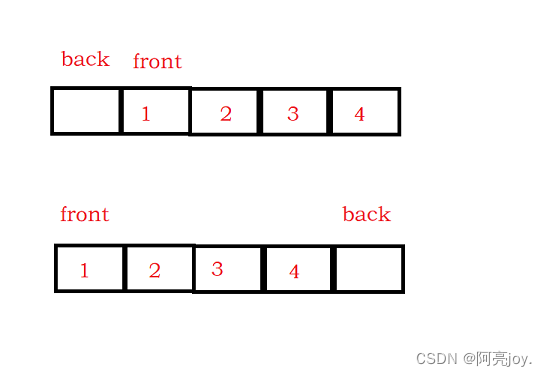
2.当循环队列不为空时,返回队尾数据return obj->a[(obj->back - 1 + obj->N) % obj->N]
int myCircularQueueRear(MyCircularQueue* obj)
{
    // if(myCircularQueueIsEmpty(obj))
    //     return -1;
    // else if(obj->back == 0)
    //     return obj->a[obj->N -1];
    // else
    //     return obj->a[obj->back - 1];
    if(myCircularQueueIsEmpty(obj))
        return -1;
    else
        return obj->a[(obj->back - 1 + obj->N) % obj->N];
}
销毁循环队列
void myCircularQueueFree(MyCircularQueue* obj)
{
    free(obj->a);
    free(obj);
}
👉一道小小的选择题👈
现有一循环队列,其队头为front,队尾为rear,循环队列长度为N,最多存储N-1个数据。其队内有效长度为( )
A.(rear - front + N) % N + 1
B.(rear - front + N) % N
C.(rear - front) % (N + 1)
D.(rear - front + N) % (N - 1)
答案:B
解析:有效长度一般是rear-front,但是循环队列中rear有可能小于front,减完之后可能是负数,所以需要+N,此时结果刚好是队列中有效元素个数,但如果rear大于front,减完之后就是有效元素个数了,再加N后有效长度会超过N,故需要%N。
👉总结👈
本篇博客主要讲解三道 OJ 题,主要考察的是大家对栈和队列性质的理解。以上就是本篇博客的全部内容了,如果大家觉得有收获的话,可以点个三连支持一下!谢谢大家啦!💖💝❣️
- 1
STDataType* a;
int top;
int capacity;
}ST;
void StackInit(ST* ps);
void StackDestroy(ST* ps);
void StackPush(ST* ps, STDataType x);
void StackPop(ST* ps);
STDataType StackTop(ST* ps);
bool StackEmpty(ST* ps);
int StackSize(ST* ps);
void StackInit(ST* ps)
{
assert(ps);
ps-a = NULL;
ps-capacity = ps->top = 0;
}
void StackDestroy(ST* ps)
{
assert(ps);
free(ps->a);
ps->a = NULL;
ps->capacity = ps->top = 0;
}
void StackPush(ST* ps, STDataType x)
{
assert(ps);
if (ps->capacity == ps->top)
{
int newcapacity = ps->capacity == 0 ? 4 : ps->capacity * 2;
STDataType* tmp = (STDataType*)realloc(ps->a, newcapacity * sizeof(STDataType));
if (tmp == NULL)
{
perror("relloc fail");
exit(-1);
}
ps->a = tmp;
ps->capacity = newcapacity;
}
ps->a[ps->top] = x;
ps->top++;
}
void StackPop(ST* ps)
{
assert(ps);
assert(!StackEmpty(ps));
ps->top--;
}
STDataType StackTop(ST* ps)
{
assert(ps);
assert(!StackEmpty(ps));
return ps->a[ps->top - 1];
}
bool StackEmpty(ST* ps)
{
assert(ps);
return ps->top == 0;
}
int StackSize(ST* ps)
{
assert(ps);
return ps->top;
}
//匿名结构体
typedef struct
{
ST pushST;
ST popST;
} MyQueue;
MyQueue* myQueueCreate()
{
MyQueue* q = (MyQueue*)malloc(sizeof(MyQueue));
StackInit(&q->pushST);
StackInit(&q->popST);
return q;
}
void myQueuePush(MyQueue* obj, int x)
{
StackPush(&obj->pushST, x);
}
int myQueuePop(MyQueue* obj)
{
//如果popST中没有数据,将pushST中的数据导过去
//popST中的数据就符号先进先出的顺序了
//如果popST中有数据,那么就直接pop popST中的数据
if(StackEmpty(&obj->popST))
{
while(!StackEmpty(&obj->pushST))
{
StackPush(&obj->popST, StackTop(&obj->pushST));
StackPop(&obj->pushST);
}
}
int front = StackTop(&obj->popST);
StackPop(&obj->popST);
return front;
}
int myQueuePeek(MyQueue* obj)
{
if(StackEmpty(&obj->popST))
{
while(!StackEmpty(&obj->pushST))
{
int top = StackTop(&obj->pushST);
StackPop(&obj->pushST);
StackPush(&obj->popST, top);
}
}
return StackTop(&obj->popST);
}
bool myQueueEmpty(MyQueue* obj)
{
return StackEmpty(&obj->pushST) && StackEmpty(&obj->popST);
}
void myQueueFree(MyQueue* obj)
{
StackDestroy(&obj->pushST);
StackDestroy(&obj->popST);
free(obj);
}
- 1
QDataType data;
struct QueueNode* next;
}QNode;
typedef struct Queue
{
QNode* head; // 头指针
QNode* tail; // 尾指针
int size; // 节点的个数
}Queue;
void QueueInit(Queue* pq);
void QueueDestroy(Queue* pq);
void QueuePush(Queue* pq, QDataType x);
void QueuePop(Queue* pq);
QDataType QueueFront(Queue* pq);
QDataType QueueBack(Queue* pq);
bool QueueEmpty(Queue* pq);
int QueueSize(Queue* pq);
void QueueInit(Queue* pq)
{
assert(pq);
pq-head = pq-tail = NULL;
pq->size = 0;
}
void QueueDestroy(Queue* pq)
{
assert(pq);
QNode* cur = pq->head;
while (cur)
{
QNode* del = cur;
cur = cur->next;
free(del);
}
pq->head = pq->tail = NULL;
}
void QueuePush(Queue* pq, QDataType x)
{
assert(pq);
QNode* newnode = (QNode*)malloc(sizeof(QNode));
if (newnode == NULL)
{
perror("malloc fail");
exit(-1);
}
else
{
newnode->data = x;
newnode->next = NULL;
}
// 队列中没有节点
if (pq->tail == NULL)
{
pq->head = pq->tail = newnode;
}
else
{
pq->tail->next = newnode;
pq->tail = newnode;
}
pq->size++;
}
void QueuePop(Queue* pq)
{
assert(pq);
assert(!QueueEmpty(pq));
// 队列中只有一个节点
if (pq->head->next == NULL)
{
free(pq->head);
pq->head = pq->tail = NULL;
}
else
{
QNode* del = pq->head;
pq->head = pq->head->next;
free(del);
//del = NULL;
}
pq->size--;
}
QDataType QueueFront(Queue* pq)
{
assert(pq);
assert(!QueueEmpty(pq));
return pq->head->data;
}
QDataType QueueBack(Queue* pq)
{
assert(pq);
assert(!QueueEmpty(pq));
return pq->tail->data;
}
bool QueueEmpty(Queue* pq)
{
assert(pq);
return pq->size == 0;
//return pq->head == NULL && pq->tail == NULL;
}
int QueueSize(Queue* pq)
{
assert(pq);
return pq->size;
}
//核心思路:
//1.入数据,往不为空的队列入,保持另一个队列为空
//2.出数据的时候,依次出队头的数据,转移到另一个队列中保存
//只剩一个数据时,pop掉
//不能改变队列的结构,只能调用提供的函数接口
typedef struct
{
Queue q1;
Queue q2;
} MyStack;
MyStack* myStackCreate()
{
// 注意局部变量,出了作用域会销毁
MyStack* st = (MyStack*)malloc(sizeof(MyStack));
//初始化队列
QueueInit(&st->q1);
QueueInit(&st->q2);
return st;
}
void myStackPush(MyStack* obj, int x)
{
// 往不为空的队列中入数据
if(!QueueEmpty(&obj->q1))
{
QueuePush(&obj->q1, x);
}
else
{
QueuePush(&obj->q2, x);
}
}
int myStackPop(MyStack* obj)
{
// 找出谁是空队列
Queue* empty = &obj->q1;
Queue* nonEmpty = &obj->q2;
if(!QueueEmpty(&obj->q1))
{
empty = &obj->q2;
nonEmpty = &obj->q1;
}
// 非空队列前N-1个数据导入空队列,剩下的一个数据就是栈顶元素
while(QueueSize(nonEmpty) > 1)
{
QueuePush(empty, QueueFront(nonEmpty));
QueuePop(nonEmpty);
}
int top = QueueFront(nonEmpty);
QueuePop(nonEmpty);
return top;
}
int myStackTop(MyStack* obj)
{
if(!QueueEmpty(&obj->q1))
{
return QueueBack(&obj->q1);
}
else
{
return QueueBack(&obj->q2);
}
}
bool myStackEmpty(MyStack* obj)
{
return QueueEmpty(&obj->q1) && QueueEmpty(&obj->q2);
}
void myStackFree(MyStack* obj)
{
QueueDestroy(&obj->q1);
QueueDestroy(&obj->q2);
free(obj);
}
- 你只能使用队列的基本操作 —— 也就是 push to back、peek/pop from front、size 和 is empty


