
Python解包及反编译: PyInstaller Extractor+uncompyle6
Python解包及反编译: PyInstaller Extractor+uncompyle6
文章目录
- Python解包及反编译: PyInstaller Extractor+uncompyle6
- 一、前言
- 二、PyInstaller Extractor解包
- 1、安装pyinstxtractor
- 2、解包
- 三、反编译uncompyle6工具使用
- 1、pip安装uncompyle6
- 2、找到主文件并编译
- 3、解压完成查看源码
- 四、一键解包并编译
一、前言
有时候会遇到一些人制作一键安装包的时候会把一些程序封装进exe里面,但我们又想拿到里面源码的情况。在这里就涉及到了解包与反编译的。
二、PyInstaller Extractor解包
目前的python主流的打包方式是使用pyinstaller,针对这种情况可以使用pyinstaller Extractor进行解包。
- 前提
- 使用pyinstaller进行打包
- 未加密
1、安装pyinstxtractor
新建一个py文件pyinstxtractor.py,然后将下面的内容拷贝进去
然后就安装好了,要使用的时候与待解包的exe文件放在同一文件夹即可
""" PyInstaller Extractor v2.0 (Supports pyinstaller 6.6.0, 6.5.0, 6.4.0, 6.3.0, 6.2.0, 6.1.0, 6.0.0, 5.13.2, 5.13.1, 5.13.0, 5.12.0, 5.11.0, 5.10.1, 5.10.0, 5.9.0, 5.8.0, 5.7.0, 5.6.2, 5.6.1, 5.6, 5.5, 5.4.1, 5.4, 5.3, 5.2, 5.1, 5.0.1, 5.0, 4.10, 4.9, 4.8, 4.7, 4.6, 4.5.1, 4.5, 4.4, 4.3, 4.2, 4.1, 4.0, 3.6, 3.5, 3.4, 3.3, 3.2, 3.1, 3.0, 2.1, 2.0) Author : Extreme Coders E-mail : extremecoders(at)hotmail(dot)com Web : https://0xec.blogspot.com Date : 26-March-2020 Url : https://github.com/extremecoders-re/pyinstxtractor For any suggestions, leave a comment on https://forum.tuts4you.com/topic/34455-pyinstaller-extractor/ This script extracts a pyinstaller generated executable file. Pyinstaller installation is not needed. The script has it all. For best results, it is recommended to run this script in the same version of python as was used to create the executable. This is just to prevent unmarshalling errors(if any) while extracting the PYZ archive. Usage : Just copy this script to the directory where your exe resides and run the script with the exe file name as a parameter C:\\path\\to\\exe\\>python pyinstxtractor.py $ /path/to/exe/python pyinstxtractor.py Licensed under GNU General Public License (GPL) v3. You are free to modify this source. CHANGELOG ================================================ Version 1.1 (Jan 28, 2014) ------------------------------------------------- - First Release - Supports only pyinstaller 2.0 Version 1.2 (Sept 12, 2015) ------------------------------------------------- - Added support for pyinstaller 2.1 and 3.0 dev - Cleaned up code - Script is now more verbose - Executable extracted within a dedicated sub-directory (Support for pyinstaller 3.0 dev is experimental) Version 1.3 (Dec 12, 2015) ------------------------------------------------- - Added support for pyinstaller 3.0 final - Script is compatible with both python 2.x & 3.x (Thanks to Moritz Kroll @ Avira Operations GmbH & Co. KG) Version 1.4 (Jan 19, 2016) ------------------------------------------------- - Fixed a bug when writing pyc files >= version 3.3 (Thanks to Daniello Alto: https://github.com/Djamana) Version 1.5 (March 1, 2016) ------------------------------------------------- - Added support for pyinstaller 3.1 (Thanks to Berwyn Hoyt for reporting) Version 1.6 (Sept 5, 2016) ------------------------------------------------- - Added support for pyinstaller 3.2 - Extractor will use a random name while extracting unnamed files. - For encrypted pyz archives it will dump the contents as is. Previously, the tool would fail. Version 1.7 (March 13, 2017) ------------------------------------------------- - Made the script compatible with python 2.6 (Thanks to Ross for reporting) Version 1.8 (April 28, 2017) ------------------------------------------------- - Support for sub-directories in .pyz files (Thanks to Moritz Kroll @ Avira Operations GmbH & Co. KG) Version 1.9 (November 29, 2017) ------------------------------------------------- - Added support for pyinstaller 3.3 - Display the scripts which are run at entry (Thanks to Michael Gillespie @ malwarehunterteam for the feature request) Version 2.0 (March 26, 2020) ------------------------------------------------- - Project migrated to github - Supports pyinstaller 3.6 - Added support for Python 3.7, 3.8 - The header of all extracted pyc's are now automatically fixed """ from __future__ import print_function import os import struct import marshal import zlib import sys from uuid import uuid4 as uniquename class CTOCEntry: def __init__(self, position, cmprsdDataSize, uncmprsdDataSize, cmprsFlag, typeCmprsData, name): self.position = position self.cmprsdDataSize = cmprsdDataSize self.uncmprsdDataSize = uncmprsdDataSize self.cmprsFlag = cmprsFlag self.typeCmprsData = typeCmprsData self.name = name class PyInstArchive: PYINST20_COOKIE_SIZE = 24 # For pyinstaller 2.0 PYINST21_COOKIE_SIZE = 24 + 64 # For pyinstaller 2.1+ MAGIC = b'MEI\014\013\012\013\016' # Magic number which identifies pyinstaller def __init__(self, path): self.filePath = path self.pycMagic = b'\0' * 4 self.barePycList = [] # List of pyc's whose headers have to be fixed def open(self): try: self.fPtr = open(self.filePath, 'rb') self.fileSize = os.stat(self.filePath).st_size except: print('[!] Error: Could not open {0}'.format(self.filePath)) return False return True def close(self): try: self.fPtr.close() except: pass def checkFile(self): print('[+] Processing {0}'.format(self.filePath)) searchChunkSize = 8192 endPos = self.fileSize self.cookiePos = -1 if endPos = searchChunkSize else 0 chunkSize = endPos - startPos if chunkSize = 100 else (pyver//10, pyver%10) print('[+] Python version: {0}.{1}'.format(self.pymaj, self.pymin)) # Additional data after the cookie tailBytes = self.fileSize - self.cookiePos - (self.PYINST20_COOKIE_SIZE if self.pyinstVer == 20 else self.PYINST21_COOKIE_SIZE) # Overlay is the data appended at the end of the PE self.overlaySize = lengthofPackage + tailBytes self.overlayPos = self.fileSize - self.overlaySize self.tableOfContentsPos = self.overlayPos + toc self.tableOfContentsSize = tocLen print('[+] Length of package: {0} bytes'.format(lengthofPackage)) return True def parseTOC(self): # Go to the table of contents self.fPtr.seek(self.tableOfContentsPos, os.SEEK_SET) self.tocList = [] parsedLen = 0 # Parse table of contents while parsedLen ARCHIVE_ITEM_DEPENDENCY # o -> ARCHIVE_ITEM_RUNTIME_OPTION # These are runtime options, not files continue basePath = os.path.dirname(entry.name) if basePath != '': # Check if path exists, create if not if not os.path.exists(basePath): os.makedirs(basePath) if entry.typeCmprsData == b's': # s -> ARCHIVE_ITEM_PYSOURCE # Entry point are expected to be python scripts print('[+] Possible entry point: {0}.pyc'.format(entry.name)) if self.pycMagic == b'\0' * 4: # if we don't have the pyc header yet, fix them in a later pass self.barePycList.append(entry.name + '.pyc') self._writePyc(entry.name + '.pyc', data) elif entry.typeCmprsData == b'M' or entry.typeCmprsData == b'm': # M -> ARCHIVE_ITEM_PYPACKAGE # m -> ARCHIVE_ITEM_PYMODULE # packages and modules are pyc files with their header intact # From PyInstaller 5.3 and above pyc headers are no longer stored # https://github.com/pyinstaller/pyinstaller/commit/a97fdf if data[2:4] == b'\r\n': # = pyinstaller 5.3 if self.pycMagic == b'\0' * 4: # if we don't have the pyc header yet, fix them in a later pass self.barePycList.append(entry.name + '.pyc') self._writePyc(entry.name + '.pyc', data) else: self._writeRawData(entry.name, data) if entry.typeCmprsData == b'z' or entry.typeCmprsData == b'Z': self._extractPyz(entry.name) # Fix bare pyc's if any self._fixBarePycs() def _fixBarePycs(self): for pycFile in self.barePycList: with open(pycFile, 'r+b') as pycFile: # Overwrite the first four bytes pycFile.write(self.pycMagic) def _writePyc(self, filename, data): with open(filename, 'wb') as pycFile: pycFile.write(self.pycMagic) # pyc magic if self.pymaj >= 3 and self.pymin >= 7: # PEP 552 -- Deterministic pycs pycFile.write(b'\0' * 4) # Bitfield pycFile.write(b'\0' * 8) # (Timestamp + size) || hash else: pycFile.write(b'\0' * 4) # Timestamp if self.pymaj >= 3 and self.pymin >= 3: pycFile.write(b'\0' * 4) # Size parameter added in Python 3.3 pycFile.write(data) def _extractPyz(self, name): dirName = name + '_extracted' # Create a directory for the contents of the pyz if not os.path.exists(dirName): os.mkdir(dirName) with open(name, 'rb') as f: pyzMagic = f.read(4) assert pyzMagic == b'PYZ\0' # Sanity Check pyzPycMagic = f.read(4) # Python magic value if self.pycMagic == b'\0' * 4: self.pycMagic = pyzPycMagic elif self.pycMagic != pyzPycMagic: self.pycMagic = pyzPycMagic print('[!] Warning: pyc magic of files inside PYZ archive are different from those in CArchive') # Skip PYZ extraction if not running under the same python version if self.pymaj != sys.version_info.major or self.pymin != sys.version_info.minor: print('[!] Warning: This script is running in a different Python version than the one used to build the executable.') print('[!] Please run this script in Python {0}.{1} to prevent extraction errors during unmarshalling'.format(self.pymaj, self.pymin)) print('[!] Skipping pyz extraction') return (tocPosition, ) = struct.unpack('!i', f.read(4)) f.seek(tocPosition, os.SEEK_SET) try: toc = marshal.load(f) except: print('[!] Unmarshalling FAILED. Cannot extract {0}. Extracting remaining files.'.format(name)) return print('[+] Found {0} files in PYZ archive'.format(len(toc))) # From pyinstaller 3.1+ toc is a list of tuples if type(toc) == list: toc = dict(toc) for key in toc.keys(): (ispkg, pos, length) = toc[key] f.seek(pos, os.SEEK_SET) fileName = key try: # for Python > 3.3 some keys are bytes object some are str object fileName = fileName.decode('utf-8') except: pass # Prevent writing outside dirName fileName = fileName.replace('..', '__').replace('.', os.path.sep) if ispkg == 1: filePath = os.path.join(dirName, fileName, '__init__.pyc') else: filePath = os.path.join(dirName, fileName + '.pyc') fileDir = os.path.dirname(filePath) if not os.path.exists(fileDir): os.makedirs(fileDir) try: data = f.read(length) data = zlib.decompress(data) except: print('[!] Error: Failed to decompress {0}, probably encrypted. Extracting as is.'.format(filePath)) open(filePath + '.encrypted', 'wb').write(data) else: self._writePyc(filePath, data) def main(): if len(sys.argv)2、解包
在使用前:
将需解包的exe与下载的pyinstxtractor.py存入同级文件夹
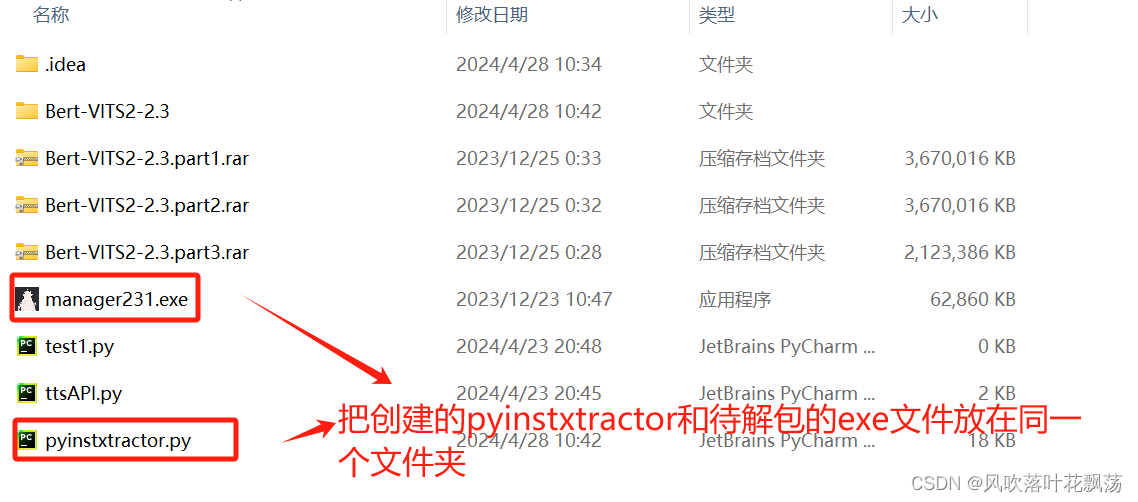
使用命令行输入如下指令, 得到exe的解包文件夹.
python pyinstxtractor.py {exe路径} 示例: python pyinstxtractor.py CreatFoder.exe运行结果:
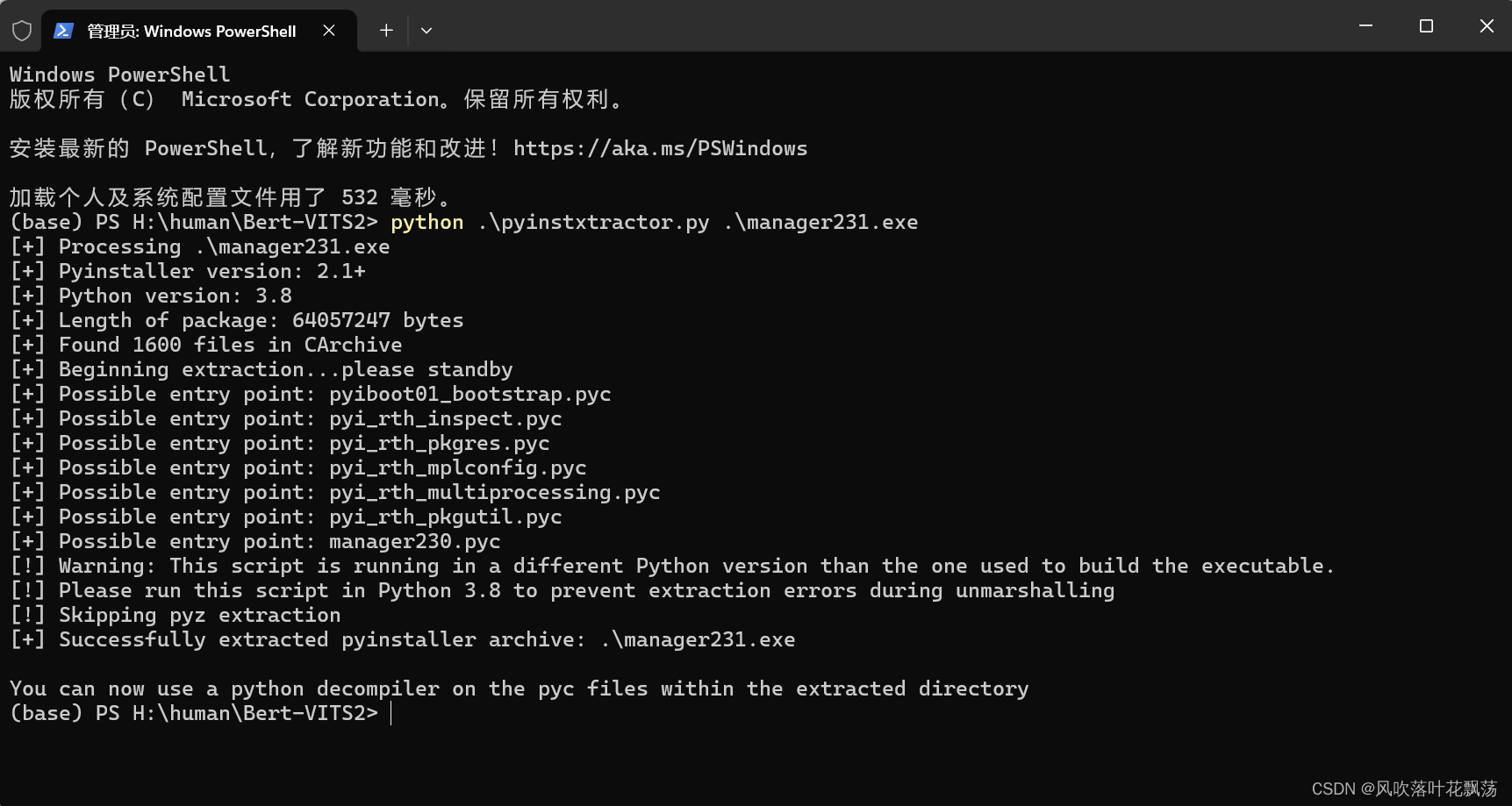
解包后文件放在以exe名字+_extracted的文件夹中
三、反编译uncompyle6工具使用
目前代码还不能用,打开会看到基本全是乱码。
在这里需要对在线pyc,pyo,pyd文件等进行反编译成py文件
1、pip安装uncompyle6
pip install uncompyle6
2、找到主文件并编译
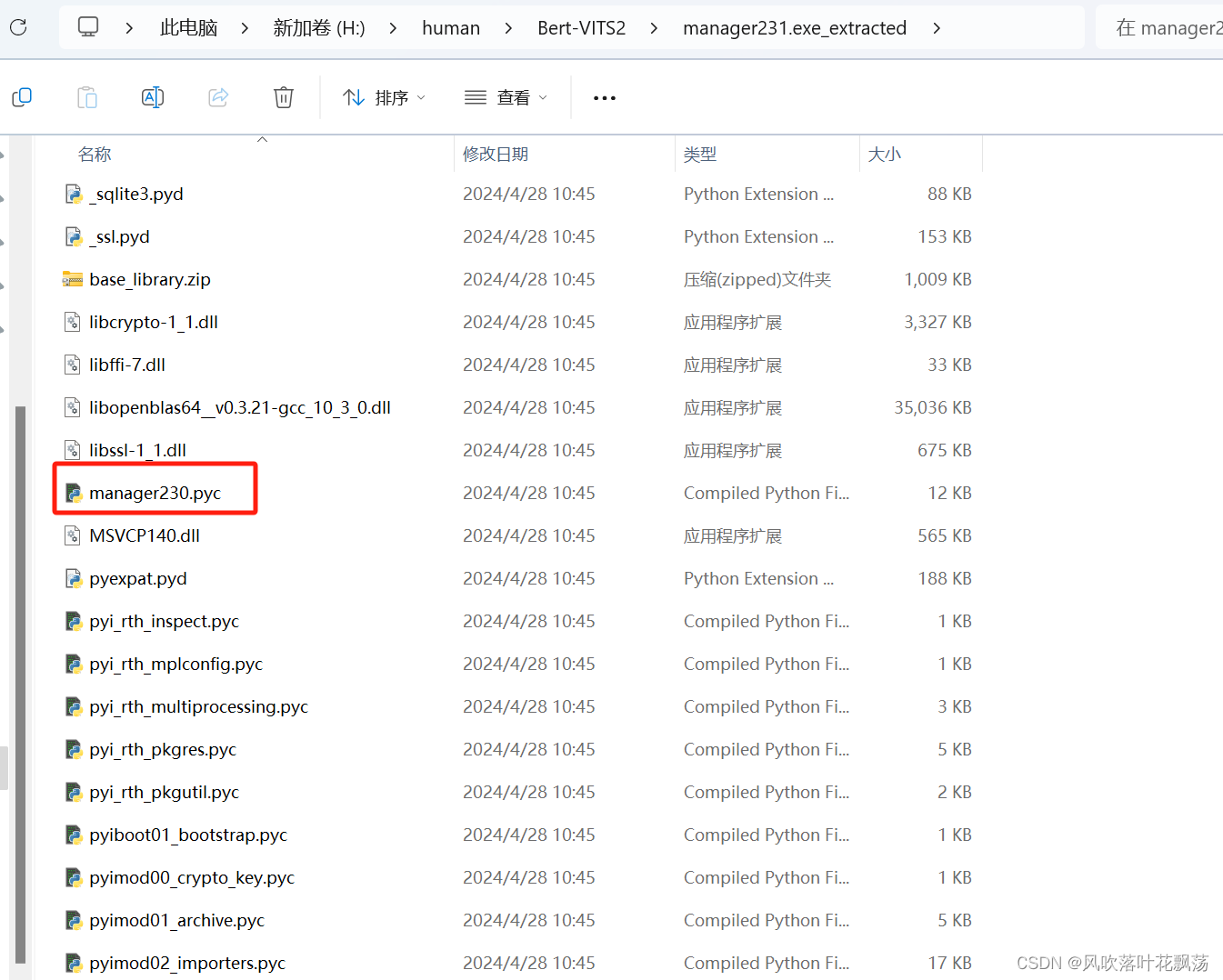
主文件的命名一般与其他库不同,有比较明显的开发者个人特征,且后缀通常是pyc。
找到之后再同级目录下输入命令行执行
uncompyle6.exe {pyc文件} >{py文件输出路径}
示例

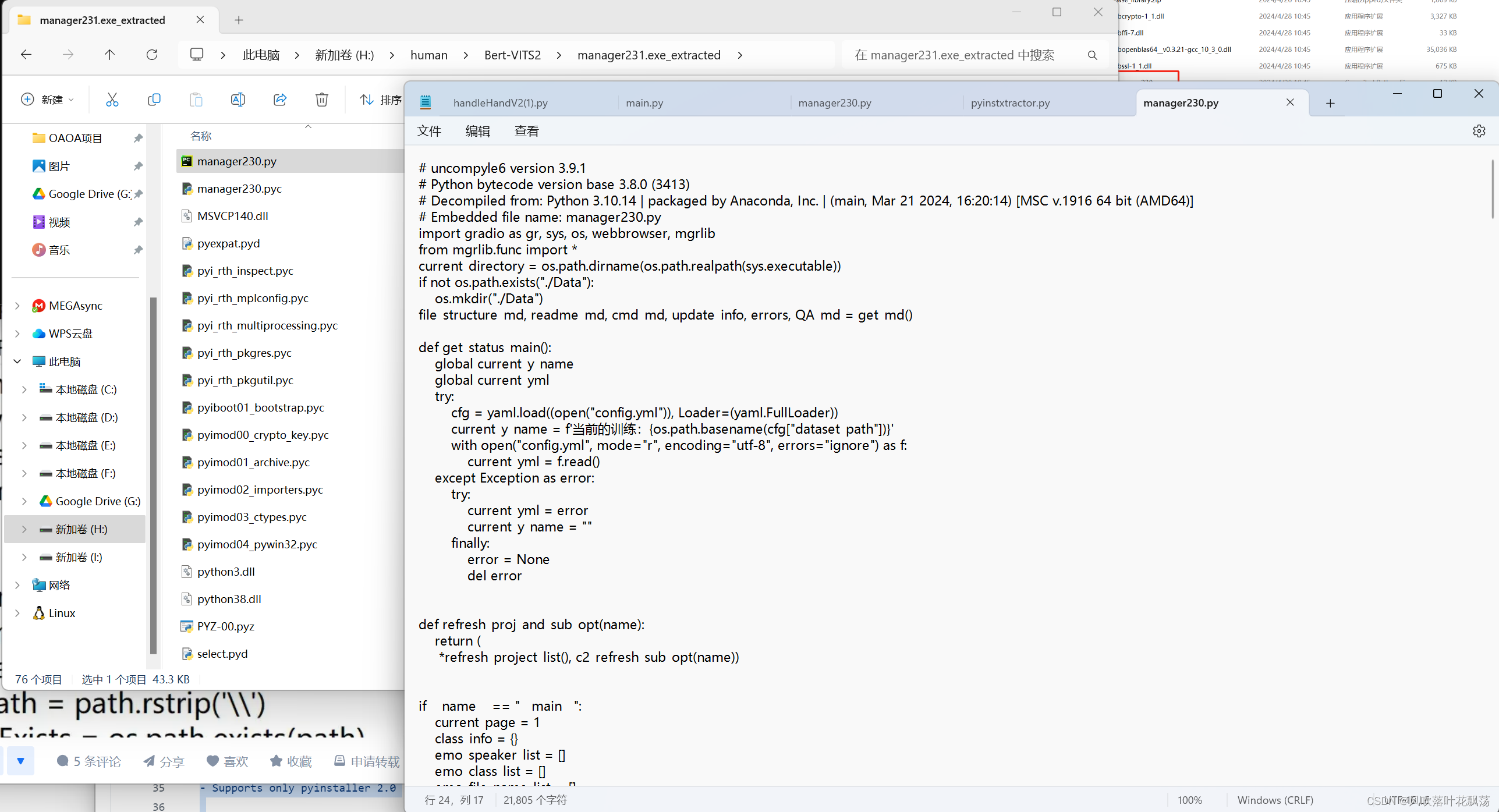
3、解压完成查看源码
无乱码,一切正常
四、一键解包并编译
很多时候我们对于解包和编译是同一流程的。为了加快获取目标源码这一步骤,我将解包和编译的流程集中了起来,源码如下:
新建一个py文件:pyinstxtractorV2.py
""" PyInstaller Extractor v2.0 (Supports pyinstaller 6.6.0, 6.5.0, 6.4.0, 6.3.0, 6.2.0, 6.1.0, 6.0.0, 5.13.2, 5.13.1, 5.13.0, 5.12.0, 5.11.0, 5.10.1, 5.10.0, 5.9.0, 5.8.0, 5.7.0, 5.6.2, 5.6.1, 5.6, 5.5, 5.4.1, 5.4, 5.3, 5.2, 5.1, 5.0.1, 5.0, 4.10, 4.9, 4.8, 4.7, 4.6, 4.5.1, 4.5, 4.4, 4.3, 4.2, 4.1, 4.0, 3.6, 3.5, 3.4, 3.3, 3.2, 3.1, 3.0, 2.1, 2.0) Author : Extreme Coders E-mail : extremecoders(at)hotmail(dot)com Web : https://0xec.blogspot.com Date : 26-March-2020 Url : https://github.com/extremecoders-re/pyinstxtractor For any suggestions, leave a comment on https://forum.tuts4you.com/topic/34455-pyinstaller-extractor/ This script extracts a pyinstaller generated executable file. Pyinstaller installation is not needed. The script has it all. For best results, it is recommended to run this script in the same version of python as was used to create the executable. This is just to prevent unmarshalling errors(if any) while extracting the PYZ archive. Usage : Just copy this script to the directory where your exe resides and run the script with the exe file name as a parameter C:\\path\\to\\exe\\>python pyinstxtractor.py $ /path/to/exe/python pyinstxtractor.py Licensed under GNU General Public License (GPL) v3. You are free to modify this source. CHANGELOG ================================================ Version 1.1 (Jan 28, 2014) ------------------------------------------------- - First Release - Supports only pyinstaller 2.0 Version 1.2 (Sept 12, 2015) ------------------------------------------------- - Added support for pyinstaller 2.1 and 3.0 dev - Cleaned up code - Script is now more verbose - Executable extracted within a dedicated sub-directory (Support for pyinstaller 3.0 dev is experimental) Version 1.3 (Dec 12, 2015) ------------------------------------------------- - Added support for pyinstaller 3.0 final - Script is compatible with both python 2.x & 3.x (Thanks to Moritz Kroll @ Avira Operations GmbH & Co. KG) Version 1.4 (Jan 19, 2016) ------------------------------------------------- - Fixed a bug when writing pyc files >= version 3.3 (Thanks to Daniello Alto: https://github.com/Djamana) Version 1.5 (March 1, 2016) ------------------------------------------------- - Added support for pyinstaller 3.1 (Thanks to Berwyn Hoyt for reporting) Version 1.6 (Sept 5, 2016) ------------------------------------------------- - Added support for pyinstaller 3.2 - Extractor will use a random name while extracting unnamed files. - For encrypted pyz archives it will dump the contents as is. Previously, the tool would fail. Version 1.7 (March 13, 2017) ------------------------------------------------- - Made the script compatible with python 2.6 (Thanks to Ross for reporting) Version 1.8 (April 28, 2017) ------------------------------------------------- - Support for sub-directories in .pyz files (Thanks to Moritz Kroll @ Avira Operations GmbH & Co. KG) Version 1.9 (November 29, 2017) ------------------------------------------------- - Added support for pyinstaller 3.3 - Display the scripts which are run at entry (Thanks to Michael Gillespie @ malwarehunterteam for the feature request) Version 2.0 (March 26, 2020) ------------------------------------------------- - Project migrated to github - Supports pyinstaller 3.6 - Added support for Python 3.7, 3.8 - The header of all extracted pyc's are now automatically fixed """ from __future__ import print_function import os import struct import marshal import zlib import sys from uuid import uuid4 as uniquename class CTOCEntry: def __init__(self, position, cmprsdDataSize, uncmprsdDataSize, cmprsFlag, typeCmprsData, name): self.position = position self.cmprsdDataSize = cmprsdDataSize self.uncmprsdDataSize = uncmprsdDataSize self.cmprsFlag = cmprsFlag self.typeCmprsData = typeCmprsData self.name = name class PyInstArchive: PYINST20_COOKIE_SIZE = 24 # For pyinstaller 2.0 PYINST21_COOKIE_SIZE = 24 + 64 # For pyinstaller 2.1+ MAGIC = b'MEI\014\013\012\013\016' # Magic number which identifies pyinstaller def __init__(self, path): self.filePath = path self.pycMagic = b'\0' * 4 self.barePycList = [] # List of pyc's whose headers have to be fixed def open(self): try: self.fPtr = open(self.filePath, 'rb') self.fileSize = os.stat(self.filePath).st_size except: print('[!] Error: Could not open {0}'.format(self.filePath)) return False return True def close(self): try: self.fPtr.close() except: pass def checkFile(self): print('[+] Processing {0}'.format(self.filePath)) searchChunkSize = 8192 endPos = self.fileSize self.cookiePos = -1 if endPos = searchChunkSize else 0 chunkSize = endPos - startPos if chunkSize = 100 else (pyver // 10, pyver % 10) print('[+] Python version: {0}.{1}'.format(self.pymaj, self.pymin)) # Additional data after the cookie tailBytes = self.fileSize - self.cookiePos - ( self.PYINST20_COOKIE_SIZE if self.pyinstVer == 20 else self.PYINST21_COOKIE_SIZE) # Overlay is the data appended at the end of the PE self.overlaySize = lengthofPackage + tailBytes self.overlayPos = self.fileSize - self.overlaySize self.tableOfContentsPos = self.overlayPos + toc self.tableOfContentsSize = tocLen print('[+] Length of package: {0} bytes'.format(lengthofPackage)) return True def parseTOC(self): # Go to the table of contents self.fPtr.seek(self.tableOfContentsPos, os.SEEK_SET) self.tocList = [] parsedLen = 0 # Parse table of contents while parsedLen ARCHIVE_ITEM_DEPENDENCY # o -> ARCHIVE_ITEM_RUNTIME_OPTION # These are runtime options, not files continue basePath = os.path.dirname(entry.name) if basePath != '': # Check if path exists, create if not if not os.path.exists(basePath): os.makedirs(basePath) if entry.typeCmprsData == b's': # s -> ARCHIVE_ITEM_PYSOURCE # Entry point are expected to be python scripts print('[+] Possible entry point: {0}.pyc'.format(entry.name)) if self.pycMagic == b'\0' * 4: # if we don't have the pyc header yet, fix them in a later pass self.barePycList.append(entry.name + '.pyc') self._writePyc(entry.name + '.pyc', data) elif entry.typeCmprsData == b'M' or entry.typeCmprsData == b'm': # M -> ARCHIVE_ITEM_PYPACKAGE # m -> ARCHIVE_ITEM_PYMODULE # packages and modules are pyc files with their header intact # From PyInstaller 5.3 and above pyc headers are no longer stored # https://github.com/pyinstaller/pyinstaller/commit/a97fdf if data[2:4] == b'\r\n': # = pyinstaller 5.3 if self.pycMagic == b'\0' * 4: # if we don't have the pyc header yet, fix them in a later pass self.barePycList.append(entry.name + '.pyc') self._writePyc(entry.name + '.pyc', data) else: self._writeRawData(entry.name, data) if entry.typeCmprsData == b'z' or entry.typeCmprsData == b'Z': self._extractPyz(entry.name) # Fix bare pyc's if any self._fixBarePycs() def _fixBarePycs(self): for pycFile in self.barePycList: with open(pycFile, 'r+b') as pycFile: # Overwrite the first four bytes pycFile.write(self.pycMagic) def _writePyc(self, filename, data): with open(filename, 'wb') as pycFile: pycFile.write(self.pycMagic) # pyc magic if self.pymaj >= 3 and self.pymin >= 7: # PEP 552 -- Deterministic pycs pycFile.write(b'\0' * 4) # Bitfield pycFile.write(b'\0' * 8) # (Timestamp + size) || hash else: pycFile.write(b'\0' * 4) # Timestamp if self.pymaj >= 3 and self.pymin >= 3: pycFile.write(b'\0' * 4) # Size parameter added in Python 3.3 pycFile.write(data) def _extractPyz(self, name): dirName = name + '_extracted' # Create a directory for the contents of the pyz if not os.path.exists(dirName): os.mkdir(dirName) with open(name, 'rb') as f: pyzMagic = f.read(4) assert pyzMagic == b'PYZ\0' # Sanity Check pyzPycMagic = f.read(4) # Python magic value if self.pycMagic == b'\0' * 4: self.pycMagic = pyzPycMagic elif self.pycMagic != pyzPycMagic: self.pycMagic = pyzPycMagic print('[!] Warning: pyc magic of files inside PYZ archive are different from those in CArchive') # Skip PYZ extraction if not running under the same python version if self.pymaj != sys.version_info.major or self.pymin != sys.version_info.minor: print( '[!] Warning: This script is running in a different Python version than the one used to build the executable.') print( '[!] Please run this script in Python {0}.{1} to prevent extraction errors during unmarshalling'.format( self.pymaj, self.pymin)) print('[!] Skipping pyz extraction') return (tocPosition,) = struct.unpack('!i', f.read(4)) f.seek(tocPosition, os.SEEK_SET) try: toc = marshal.load(f) except: print('[!] Unmarshalling FAILED. Cannot extract {0}. Extracting remaining files.'.format(name)) return print('[+] Found {0} files in PYZ archive'.format(len(toc))) # From pyinstaller 3.1+ toc is a list of tuples if type(toc) == list: toc = dict(toc) for key in toc.keys(): (ispkg, pos, length) = toc[key] f.seek(pos, os.SEEK_SET) fileName = key try: # for Python > 3.3 some keys are bytes object some are str object fileName = fileName.decode('utf-8') except: pass # Prevent writing outside dirName fileName = fileName.replace('..', '__').replace('.', os.path.sep) if ispkg == 1: filePath = os.path.join(dirName, fileName, '__init__.pyc') else: filePath = os.path.join(dirName, fileName + '.pyc') fileDir = os.path.dirname(filePath) if not os.path.exists(fileDir): os.makedirs(fileDir) try: data = f.read(length) data = zlib.decompress(data) except: print('[!] Error: Failed to decompress {0}, probably encrypted. Extracting as is.'.format(filePath)) open(filePath + '.encrypted', 'wb').write(data) else: self._writePyc(filePath, data) def main(): if len(sys.argv) {}".format(filePath, filePath.replace('pyc', 'py')) # 使用subprocess模块执行命令 process = subprocess.Popen(command, shell=True) process.wait() # 等待命令执行完成 print(command) os.remove(filePath) return True except Exception as e: print(e) return False def excutor(): print('检查是否已安装uncompyle6') # 检查是否已安装uncompyle6 try: subprocess.check_output(['uncompyle6', '--version']) print("uncompyle6 is already installed.") except (subprocess.CalledProcessError,FileNotFoundError): print("uncompyle6 is not installed. Installing...") subprocess.call(['pip', 'install', 'uncompyle6']) currentPath=os.path.dirname(os.path.abspath(__file__)) targe=os.path.basename(sys.argv[1]) print('解包完成,开始反编译') targeDir=os.path.join(currentPath,targe+'_extracted') with concurrent.futures.ThreadPoolExecutor(max_workers=8) as excutor: futures=[] for root,dirs,files in os.walk(targeDir): for file in files: filePath=os.path.join(root,file) if filePath.endswith('pyc'): task =excutor.submit(handle,filePath) futures.append(task) for future in concurrent.futures.as_completed(futures): ret=future.result() if __name__ == '__main__': main() excutor()- 使用
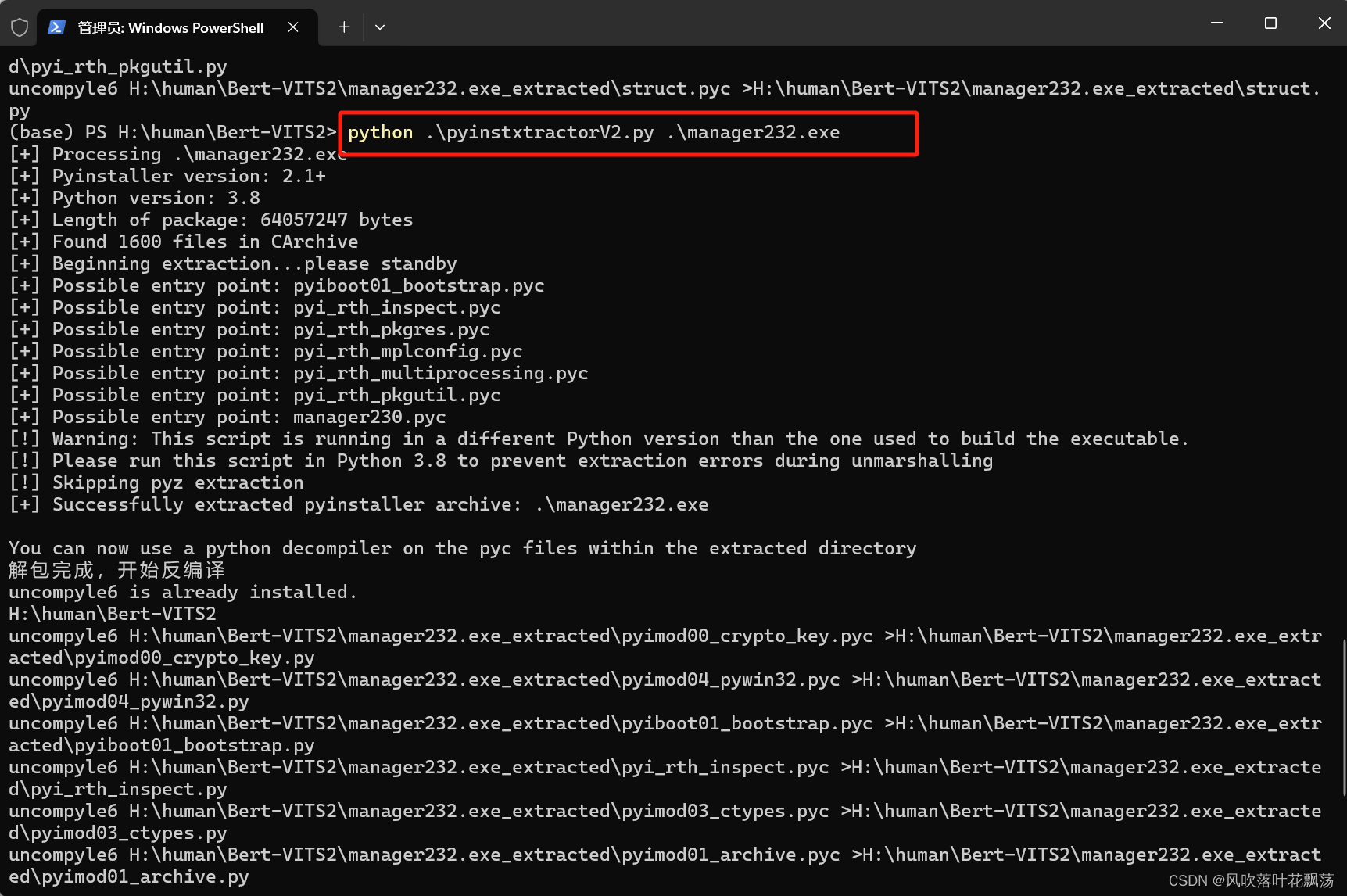
将pyinstxtractorV2.py文件与待处理的exe文件放置在同一目录并执行:
示例:python .\pyinstxtractorV2.py .\manager232.exe
- 前提
免责声明:我们致力于保护作者版权,注重分享,被刊用文章因无法核实真实出处,未能及时与作者取得联系,或有版权异议的,请联系管理员,我们会立即处理! 部分文章是来自自研大数据AI进行生成,内容摘自(百度百科,百度知道,头条百科,中国民法典,刑法,牛津词典,新华词典,汉语词典,国家院校,科普平台)等数据,内容仅供学习参考,不准确地方联系删除处理! 图片声明:本站部分配图来自人工智能系统AI生成,觅知网授权图片,PxHere摄影无版权图库和百度,360,搜狗等多加搜索引擎自动关键词搜索配图,如有侵权的图片,请第一时间联系我们,邮箱:ciyunidc@ciyunshuju.com。本站只作为美观性配图使用,无任何非法侵犯第三方意图,一切解释权归图片著作权方,本站不承担任何责任。如有恶意碰瓷者,必当奉陪到底严惩不贷!


