
【Linux】文件描述符 - fd
文章目录
- 1. open 接口介绍
- 1.1 代码演示
- 1.2 open 函数返回值
- 2. 文件描述符 fd
- 2.1 0 / 1 / 2
- 2.2 文件描述符的分配规则
- 3. 重定向
- 3.1 dup2 系统调用函数
- 4. FILE 与 缓冲区

1. open 接口介绍
使用 man open 指令查看手册:
#include
#include
#include
int open(const char *pathname, int flags);
int open(const char *pathname, int flags, mode_t mode);
pathname: 要打开或创建的目标文件
flags: 打开文件时,可以传入多个参数选项,用下面的一个或者多个常量进行“或”运算,构成flags。
参数:
		O_RDONLY: 只读打开
		O_WRONLY: 只写打开
		O_RDWR  : 读,写打开
				  这三个常量,必须指定一个且只能指定一个
		O_CREAT : 若文件不存在,则创建它。需要使用mode选项,来指明新文件的访问权限
		O_APPEND: 追加写
返回值:
		成功:新打开的文件描述符
		失败:-1
open 函数具体使用哪个,和具体应用场景有关。如:目标文件不存在,需要 open 创建,则第三个参数表示创建文件的默认权限;否则使用两个参数的 open。
write read close lseek ,类比 C 文件相关接口。
1.1 代码演示
操作文件,除了使用 C 语言的接口【Linux】回顾 C 文件接口,还可以采用系统接口来进行文件访问;
写文件:
#include #include #include #include #include #include int main() { umask(0); int fd = open("myfile", O_WRONLY | O_CREAT, 0644); if (fd读文件:
#include #include #include #include #include #include int main() { int fd = open("myfile", O_RDONLY); if (fd 0) { printf("%s", buf); } else { break; } } close(fd); return 0; }1.2 open 函数返回值
在认识返回值之前,先来认识两个概念:系统调用 和 库函数 :
- fopen fclose fread fwrite 都是 C 标准库当中的函数,我们称之为库函数(libc);
- 而 open close read write lseek 都属于系统提供的接口,称之为系统调用接口;
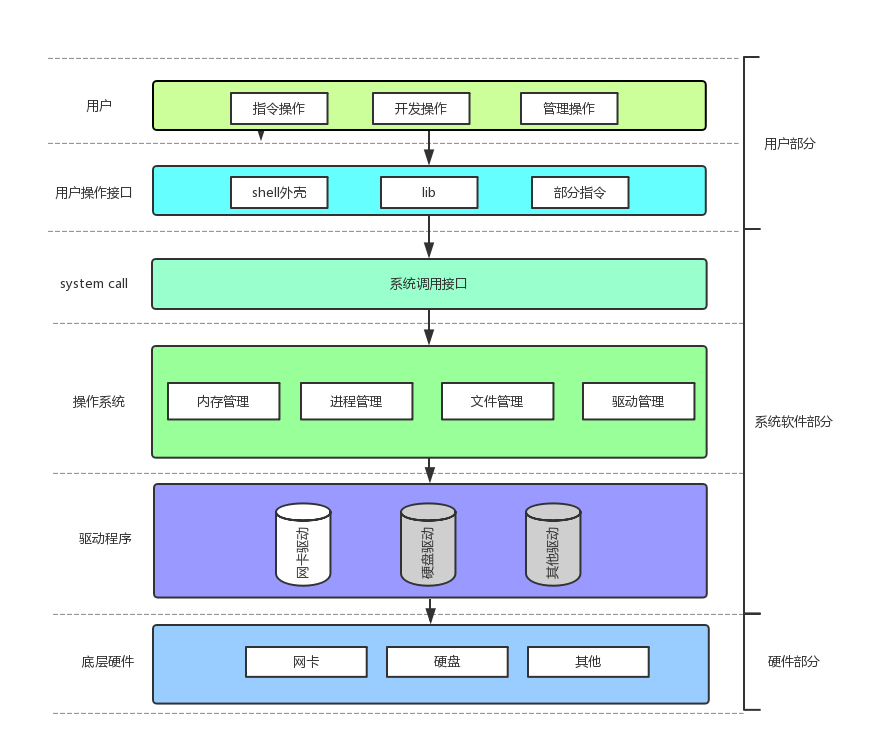
- 系统调用接口与库函数的关系如上图;
- 所以,可以认为,f# 系列的函数,都是对系统调用的封装,方便二次开发。
2. 文件描述符 fd
- 文件描述符的本质,就是数组下标!!!
2.1 0 / 1 / 2
- Linux 进程默认情况下会有 3 个缺省打开的文件描述符,分别是标准输入 0,标准输出 1,标准错误 2;
- 0,1,2 对应的物理设备一般是:键盘,显示器,显示器;
- 所以输入输出也可以采用如下方式:
#include
#include
#include
#include
#include
int main()
{
    char buf[1024];
    ssize_t s = read(0, buf, sizeof(buf));
    if (s > 0)
    {
        buf[s] = 0;
        write(1, buf, strlen(buf));
        write(2, buf, strlen(buf));
    }
    return 0;
}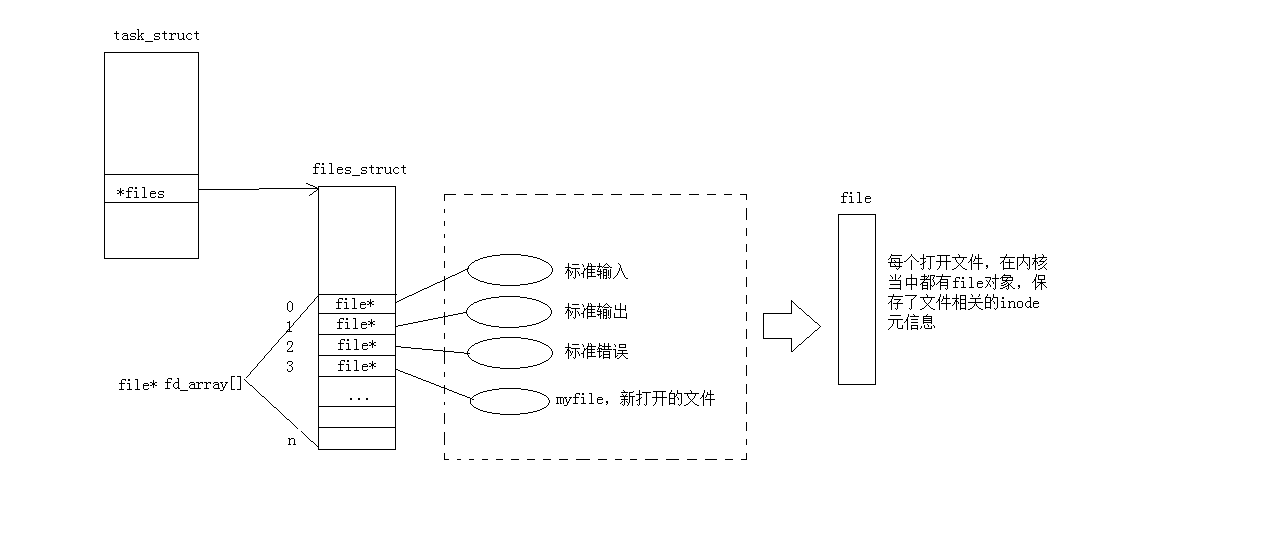
- 现在我们知道,文件描述符就是从 0 开始的小整数;
- 当我们打开文件时,操作系统在内存中要创建相应的数据结构来描述目标文件,于是就有了 file 结构体,表示一个已经打开的文件对象;
- 而进程执行 open 系统调用,就必须让进程和文件关联起来;
- 每个进程都有一个指针 *files ,指向一张表 files_struct ,该表最重要的部分就是包含一个指针数组,每个元素都是一个指向打开文件的指针;
- 所以,本质上,文件描述符就是该数组的下标,只要拿着文件描述符,就可以找到对应的文件。
2.2 文件描述符的分配规则
直接看代码:
#include #include #include #include int main() { int fd = open("myfile", O_RDONLY); if (fd输出发现是 fd: 3 ,
关闭 0 或者 2,再看:
#include #include #include #include int main() { close(0); //close(2); int fd = open("myfile", O_RDONLY); if (fd发现结果是:fd: 0 或者 fd: 2 ,
可见,文件描述符的分配规则:在 files_struct 数组当中,找到当前没有被使用的最小的一个下标,作为新的文件描述符,会分配给最新打开的文件。
3. 重定向
那如果关闭 1 呢?看代码:
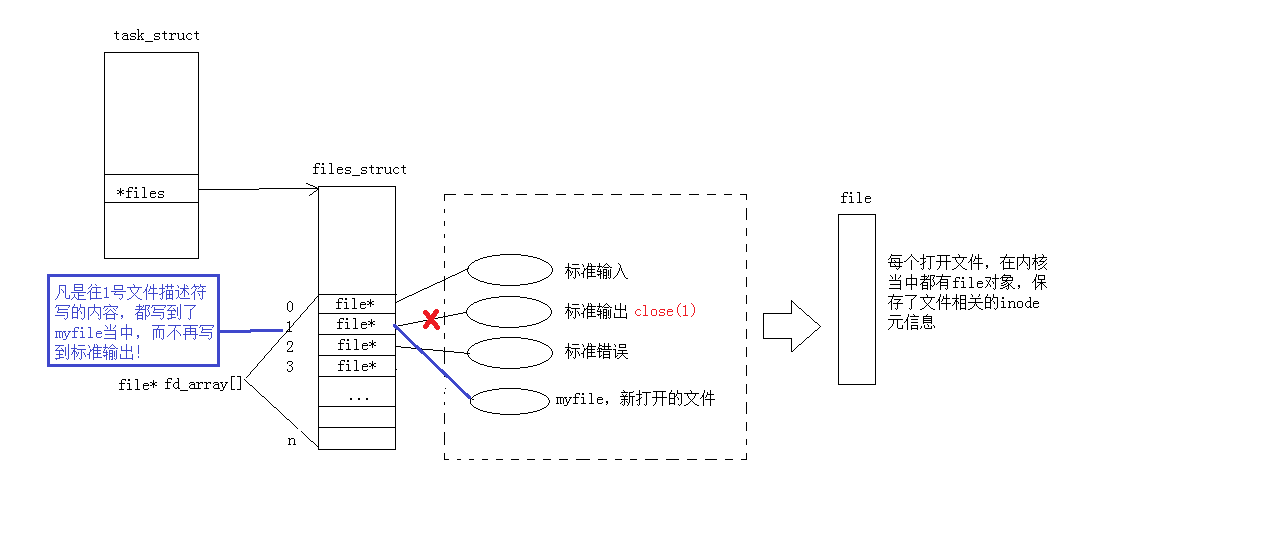
#include #include #include #include #include int main() { close(1); int fd = open("myfile", O_WRONLY | O_CREAT, 00644); if (fd此时,我们发现,本来应该输出到显示器上的内容,输出到了文件 myfile 当中,其中 fd = 1。这种现象叫做输出重定向。
常见的重定向有:> ,>> ,
那重定向的本质是什么呢?
3.1 dup2 系统调用函数
函数原型如下:
#include int dup2(int oldfd, int newfd);
函数简介:
makes newfd be the copy of oldfd, closing newfd first if necessary, but note the following: 将newfd设置为oldfd的副本,并在必要时先关闭newfd,但请注意以下事项: * If oldfd is not a valid file descriptor, then the call fails, and newfd is not closed. 如果oldfd不是有效的文件描述符,则调用失败,newfd不会关闭。 * If oldfd is a valid file descriptor, and newfd has the same value as oldfd, then dup2() does nothing, and returns newfd. 如果oldfd是一个有效的文件描述符,并且newfd与oldfd具有相同的值,那么dup2()什么都不做,并返回newfd。
示例代码:
#include #include #include int main() { int fd = open("./log", O_CREAT | O_RDWR, 0644); if (fd- printf 是 C 库当中的 IO 函数,一般往 stdout 中输出,但是 stdout 底层访问文件的时候,找的还是 fd:1 ;
- 但此时 fd:1 下标所表示的内容已经变成了 log 的地址,不再是显示器文件的地址;
- 所以,输出的任何消息都会往文件中写入,进而完成输出重定向。
4. FILE 与 缓冲区
- 因为 IO 相关函数与系统调用接口对应,并且库函数封装系统调用,所以本质上,访问文件都是通过 fd 访问的。
- 所以 C 库当中的 FILE 结构体内部,必定封装了 fd。
- 缓冲区就是一块内存区域,其存在目的是为了提升使用者的效率(用空间换时间)。
- 我们这里说的缓冲区是语言层面的缓冲区,也就是 C 自带的缓冲区,跟内核中的缓冲区没有关系。
- 缓冲区刷新方式:
- 无缓冲 - 无刷新;
- 行缓冲 - 行刷新 :写满一行才刷新,我们平时写代码经常会遇到缓冲区的问题;
- 全缓冲 - 全部刷新:在普通文件中写入时,缓冲区被写满,才刷新!
- 强制刷新:使用各种方法让缓冲区强制刷新,如:fflush() 函数;
- 自动刷新:程序退出的时候会自动刷新。
来段代码研究一下:
#include
#include
int main()
{
    const char* msg0 = "hello printf\n";
    const char* msg1 = "hello fwrite\n";
    const char* msg2 = "hello write\n";
    printf("%s", msg0);
    fwrite(msg1, strlen(msg0), 1, stdout);
    write(1, msg2, strlen(msg2));
    fork();
    return 0;
}
运行出结果:
hello printf
hello fwrite
hello write
但如果对进程实现输出重定向呢?./a.out > file ,我们发现结果变成了:
hello write
hello printf
hello fwrite
hello peintf
hello fwrite
我们发现 printf 和 fwrite(库函数)都输出了 2 次,而 write 只输出了一次(系统调用)。
为什么呢?肯定和 fork 有关:
- 一般 C 库函数写入文件是全缓冲的,而写入显示器是行缓冲。
- printf fwrite 库函数会自带缓冲区(进度条例子可以说明【Linux】编写第一个小程序:进度条),当发生重定向到普通文件时,数据的缓冲方式由行缓冲变成了全缓冲。
- 而我们放在缓冲区中的数据,就不会被立即刷新,即使是 fork 之后;
- 但是进程退出之后,会统一刷新,写入文件当中。
- 但是 fork 的时候,父子数据会发生写时拷贝,所以当你父进程准备刷新的时候,子进程也就有了同样的一份数据,随即产生两份数据。
- write 没有变化,说明没有所谓的缓冲。
综上:printf fwrite 库函数会自带缓冲区,而 write 系统调用没有带缓冲区。另外,我们这里所说的缓冲区,都是用户级缓冲区。其实为了提升整机性能,OS 也会提供相关内核级缓冲区,不过不在我们讨论范围之内。那这个缓冲区谁提供呢?printf fwrite 是库函数,writre 是系统调用,库函数在系统调用的“上层”,是对系统调用的“封装”,但是 write 没有缓冲区,而 printf fwrite 有,足以说明,该缓冲区是二次加上的,又因为是 C,所以由 C 标准库提供。
END
- 文件描述符的本质,就是数组下标!!!


